Monday, 8 June 2015

GAWF/Animal Action's Equine Team in Paros - by Mary Price

Mary Price is one of the people on Paros who helps us to plan and organise our outreach visits there.  Both Mary and Marielli help us a great deal by spotting equines in need and contacting their owners to ask whether they would be willing for our team to treat their animals and teach them about improving welfare, which makes our visits even more worthwhile. We thank Mary, who is a journalist, for this contribution.

Two workshops on equine welfare were the highlight of the 2015 GAWF visit to the island of Paros in the Greek Cyclades.
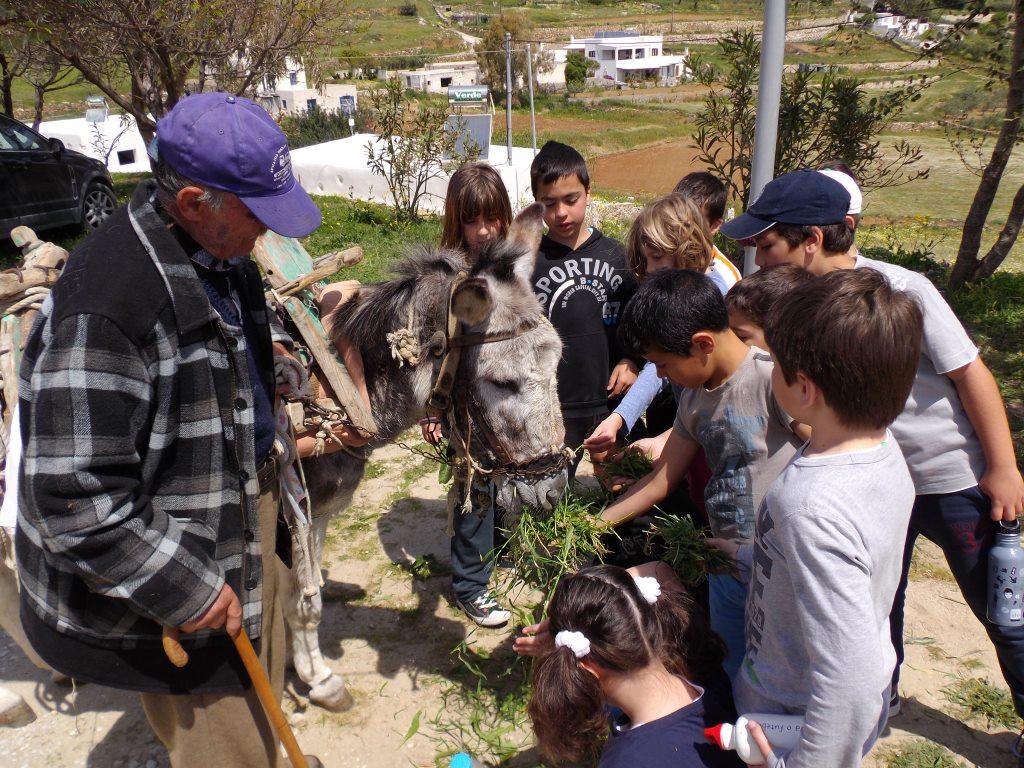
School children feeding a donkey
On the opening of their three day stay Vet Elisa Geskou and Farrier Aris Vlachakis  were joined by 3rd,4th and 6th grade children from Kostos’ Primary School for a workshop on donkey welfare.   This was a unique experience for everybody.
Teaching children about donkey welfare
They watched in fascinated silence as donkeys had their teeth examined and treated. As she worked, Elisa explained that, like people, donkeys need tooth care. ‘If teeth are too sharp or have hooks it makes it difficult for a donkey to eat’ she told the children.  ‘And if they cannot eat they die slowly and painfully from starvation’.
School children watching and learning
‘It’s the same with feet’ added Aris, donkeys need their feet cleaned and if their nails are too long they have to be trimmed. Otherwise it is hard for them to walk’. Heads nodded sagely, this was all new information.

 The lesson went on for the best part of an hour and the team took the opportunity to explain that donkeys can live for 40 years and during that time need food, water, shelter from heat, cold and rain and above all they should not be hobbled.
An example of hobbling

‘No hobbling’ agreed the children, it is not legal in Greece’  ‘I’m surprised they said this’ observed Elisa, ‘because almost every animal on this island is hobbled - often with disastrous consequences.’  She added ‘maybe with more work the new generation will change this practice. ‘But,’ she pointed out, ‘it is always slow to change old ways.’
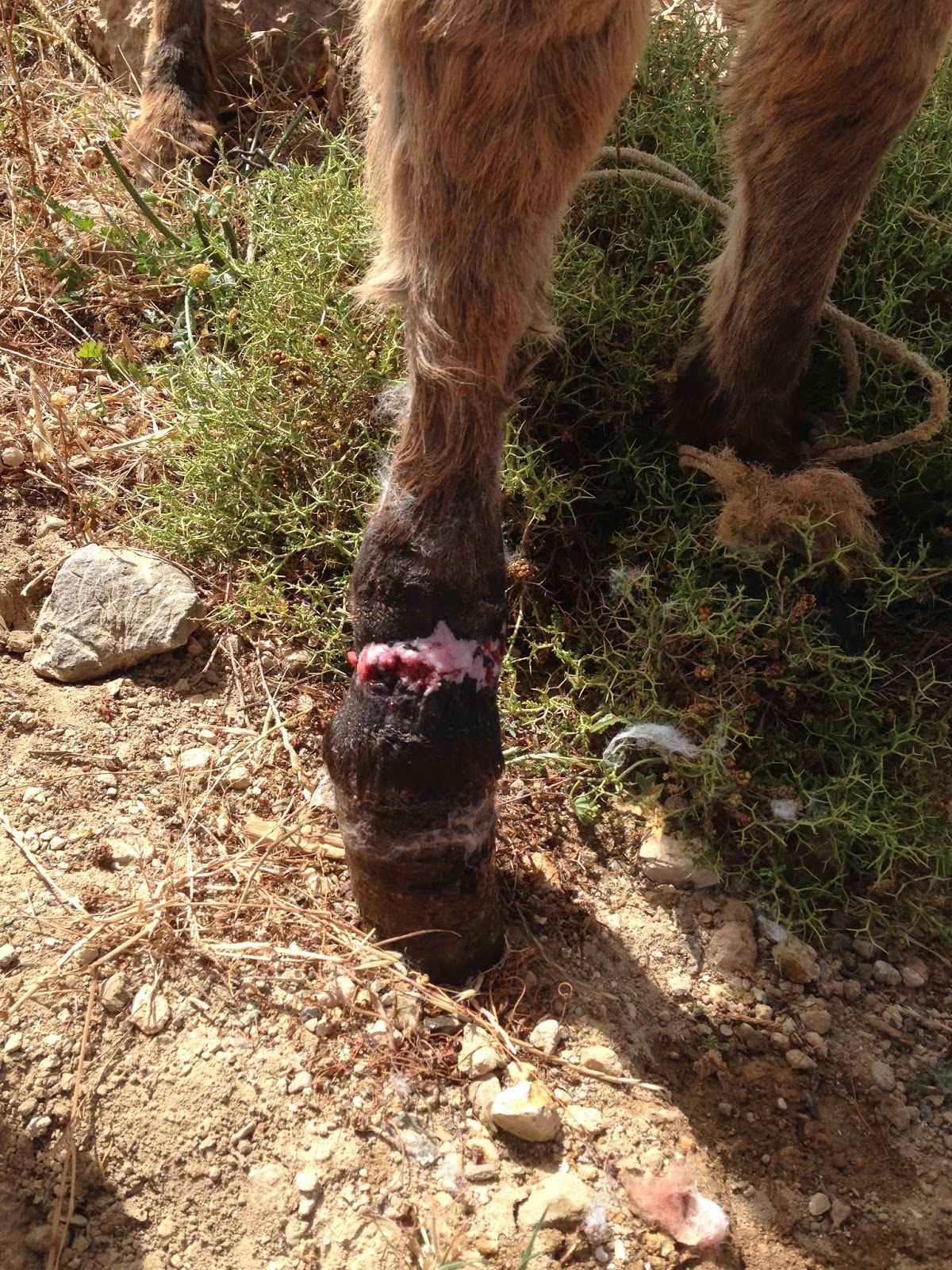
A common injury from hobbling
On day two in their drive to encourage people to change the island tradition of hobbling the GAWF team were joined for the second year by Nick Turck from FARMCARE UK (www.farmcareuk.com).
Over the last year GAWF and Farmcare have worked together to find the most effective ways to demonstrate the benefits of electric fencing to the rural community of Paros.  Farmcare has generously volunteered funds, time and effort to work with GAWF to develop a strategy for managing electric fencing in a way which is suitable for the conditions which are particular to farming on Paros.
Elisa and Nick demonstrating safe use of fencing as an alternative to hobbling
Cost and the danger of fire caused by sparks from the fencing in the hot dry summers were two of the major concerns for equine owners. Cost is minimal and is offset by the economic returns from the value of undamaged animals and simple management rules mitigate against fire - was the message from Nick Turck.
Elisa giving an educational presentation
Elisa researched the damage done to animal skeletal development, not to mention the high casualty rate which is caused by hobbling. To illustrate her findings she made a powerful presentation to those who joined the workshop. This generated a lot of questions and promises of action. It remains to be seen if change does take place but the knowledge was passed on and it was encouraging that the Paros Mayor Markos Kovaios came to observe a demonstration of the all round benefits of electric fencing in action.

 As Nick Turck pointed out ‘This year I think we have communicated everything about electric fencing. The local teams are now skilled in every aspect of it. Each visitor to the fencing workshop was given a set of comprehensive leaflets packed with information on where to find support and how to work on new ways of welfare management.
An elderly donkey receiving treatment
Guided by the tireless local organizer, Marielli Andreopoulou, and state vet Nikos Tsigonias, the GAWF team treated  46  donkeys, mules and horses during their visit. As well as routine treatment they had to deal with a series of casualties.  A donkey kept alive with a leg broken as a direct result of hobbling,  a series of  neglected donkeys all hobbled too tightly, a foal with a knee abscess, now happily treated, and a horse with a broken knee.
Educating a donkey owner

‘It’s  a normal tally’ said Elisa before adding ‘but the great thing is that now we are known on the island, people are coming to us. It’s taken five years, but people trust us here which is good. It means we are moving forward’.
Treating long feet
With that the team moved on to care for the equines on Naxos - an island which has embraced electric fencing but has its own challenges…

You can read a report about the team’s visit to Naxos here 
Aris trimming feet
More hobbling

Injecting a donkey
Feet before trimming
 
Feet after trimming


Clare's stay in Greece - part two

After the distress I encountered last week on my arrival in Greece, my feeling of sadness and paranoia lifted in the forthcoming days, helped greatly by the beautiful and peaceful surroundings of my new home.
Poppy and Dexter having a rest near a local church

My olive mill house is situated in a small hamlet in the north of the island, with the wonderful owners, Nikos and Claire on one side and the old farmhouse which is also rented out, on the other side.  My garden leads onto thick woods which run down to the sea and is a peaceful haven for my stay.  Nikos and Claire have a well-tended and productive organic fruit and vegetable garden which I have free access to whenever I wish. At the moment, there are courgettes, lettuces and cucumbers in abundance with tomatoes and strawberries on their way.  I love the natural simplicity of wandering over in the sunshine and picking something to cook for dinner.  It makes staying in a joy!

It only took a few days to meet some of the local characters; Greeks, holiday makers and ex-pats, so I already feel at home, especially when people wave as I drive past!  My worries about feeling isolated whilst here disappeared very quickly.  Days have formed a familiar pattern of taking the dogs for a morning walk along the many trails and paths, doing my work on my laptop, relaxing in the sunshine and eating Claire’s courgette pie!  Taking the dogs with me for dinner, however, is a stressful experience as Dexter clearly wants to have fun with the local cat population.  I made the mistake of tying him to my table on one early occasion to restrain him but to my horror, on seeing a cat, he took the table with him.  I now tie him to my chair leg to anchor him to avoid any more embarrassing episodes.

As I mentioned in my first blog, the horrific practice of putting down poison to ‘control’ the local dog population is all too prevalent and so I made an appointment with my nearest vet, to establish exactly their location in case I needed them at short notice, but also to find out what to do if either Poppy or Dexter were poisoned.  They explained what to do, and demonstrated how to administer the necessary drugs.  They spent at least half an hour with me and made no charge for this advice and help, as they said it was ‘in the interests of animal welfare’.  I went away with a supply of drugs and was reassured that I could help my dogs if I needed to.

Because of the situation with poisoning, although I have also been reassured by various people here that there have been no cases of dogs being poisoned in this part of the island, precautions become a necessary part of everyday life.  I know from work in animal welfare, that poison is mixed into food and often left near public waste bins, by the side of the road and in public places such as parks.  So I keep the dogs on a tight rein when out and about but have made a decision to let them roam free on the beaches and the rural walks as I feel that these are not areas of risk.
Clare and the dogs relaxing at home
 
As I’m now nearing the end of the day, and we still have some sunshine, I’m going to take the dogs for another walk.  No doubt there will be more news from this beautiful island next week!

Thursday, 4 June 2015

Kasos 2015 – a satisfying but emotional outreach for the GAWF/Animal Action Equine Team, Anna Stamatiou, Trustee.


Farrier Giannis, Vet Cleo and GAWF/Animal Action Trustee Anna Stamatiou

 This year’s visit to Kasos – the fourth by GAWF/Animal Action’s Equine Team – got off to a very shaky start.  In spite of our most energetic campaign so far to alert the islanders that we were coming, no one had thought to let us know in advance about a donkey with a broken leg.  I only heard about it the day before Cleo and Giannis were due to arrive – and that only because of a casual message, shouted over a garden wall.  Given how difficult it is to treat any fracture in equines, we promised to come and see the case as a top priority… but feared the worst.  So, next morning, seeking directions as we went, we found the poor animal lying on a patch of earth in the middle of the village.  Cleo took one look and shook her head.  A foreleg was badly fractured, the skin covering the break a broken and oozing mess, and there were flies everywhere.  The elderly owner was distraught but soon agreed that the only thing that could be done for her animal now was to end its torment by putting it quietly to sleep.  We said we would come back and do it a little later so that she could arrange for people to come and take the body away as soon as it was all over.  (In fact we also thought it best to give poor Mrs Calliope a little time to come to terms with the idea).  Cleo calculated that the donkey had been suffering for about three weeks, which made the Team feel terrible, but there was a silver lining in that no one felt like giving us an argument.  Had the injury been fresher, we might have had a lot more persuading to do.  But by now everyone could see that the animal’s condition was worsening and that euthanasia was truly the best option.

The second gelding
Another near-disaster loomed when we heard that Kostas Perselis, the man who cares for the ponies and donkeys that are owned or looked after by the Municipality, had been called away suddenly, and had left the island the morning the team arrived.  Since we had intended to carry out gelding procedures on the two male Shetland ponies in his care, it looked as though we might have to abandon that plan altogether.  We got to the place where the growing – and increasingly inbred – herd is kept, to find all eight of the little ruffians running about in a large paddock. Not a halter, nor even a handy length of rope, in sight.  I thought… “Right, that’s it.  Game over.”  But I had reckoned without the ingenuity of the locals and the pony-catching skills of Giannis.  Someone conjured a length of rope from somewhere and we managed to scare the first male into his smallish stable.  Giannis strode over with a determined look on his face and out of the shadows came the sounds of a scuffle, liberally seasoned with some pretty salty language.  Soon after, Giannis reappeared at the stable door with one end of the rope in his hand.  For a moment that was all that could be seen but then out came the stallion – with a temporary rope halter on his head and all four brakes jammed on hard.  Being an intelligent beast, the pony soon figured out that Giannis a) was stronger than him and b) meant him no real harm (unless, that is, you count the loss of his manhood)!  Cleo did the surgery, which went very smoothly, although the anaesthetic took a little longer to wear off than we expected.  Giannis had to do steadying head-holding duty while local lad, Christos, hung on to a tail.  Minutes later we managed to catch the second pony and repeat the above scenes more or less exactly.  Now the small herd will stop growing, which will prevent future birth defects.  All of its new members are descended from one original pair so it was only a matter of time before either mental or physical disabilities appeared.  (We will have to wait and see whether any of the females is carrying a male foal… we may not be out of the woods yet)!

We devoted most of the afternoon to what I have come to think of as “house calls” scouring the village of Aghia Marina for animals we know about, many of which we have seen on previous visits, and looking for new ones.  The first and most difficult emotionally was the return visit to Mrs Calliope’s donkey.  The poor lady wept openly as Cleo administered the drugs and her donkey died.


Draining the wound
The wound is treated and dressed
The rest of the calls went fairly uneventfully until we visited an elderly couple that reported one of their two donkeys was lame.  As Cleo’s fingers disappeared inside a wound just above the hoof and nasty stuff flowed out, it was clear that Cleo was dealing with a seriously deep infection that, if left untreated, would certainly have proved life-threatening.  Once again we had come across a case that we ought to have been told about in advance so that we could have made sure to give it priority, and once again it was by sheer luck that we were there at the critical moment. It may sound like an exaggeration to say that we saved a life that day but it’s almost certainly true.  If the young man, Christos, who Cleo trained on the spot to clean and dress the wound and administer a daily antibiotic injection, carries out his tasks (and there’s every indication that he will) that donkey will heal well and survive.  Now there’s only one thing left… to convince the owners to change their practice of tethering their animals using a thin piece of rope tied around the pastern.  Hmmm.  This may not be achievable any time soon.  Hope for changes of this kind really lies with showing the next generation better ways of doing things.
 
Damaged pastern after treatment

We rounded off the working day by making a repeat visit to a donkey with ballerina syndrome.  Giannis had treated it on our previous visit two years ago and was pleased to find it improved. Cleo used her enormous cutters to reduce a very overgrown tooth and the whole Team did its best to impress on an owner that being hugely overweight is as unhealthy for donkeys as it is for humans.  Giannis typically reduced the lecture to a memorably minimalist instruction:  “Lose the corn, mate”.

Essential farriery
Before we left Kasos the next day, Cleo did a final check on the geldings, which were doing fine, and also changed the dressing on the infected leg.  The swelling was reduced and more weight was being carried on it – both good signs. We went to the chemist and ordered extra needles for the antibiotic injections and all the dressings that would be needed for the wound. As we left, Cleo declared herself content with the Kasos leg of this early summer outreach trip because, as she said, “We did three very different procedures, but in each case we made a really meaningful difference to the welfare of those animals”.

Amen to that.


Anna Stamatiou, Trustee

Thursday, 28 May 2015

Clare's stay in Greece - part one

Clare is one of our fabulous UK office volunteers and when she told us about her plans for an extended stay in Greece, we thought our supporters might enjoy reading about her experiences. Here, in her first post, she tells us about her arrival in Greece and a very worrying but sadly still common case of poisoning...

As an occasional and very willing volunteer helping GAWF with their mission to help the animals, I decided to write a blog about my stay in Greece as I felt sure I would experience some animal welfare issues during my time but also to let people know what a beautiful country it is, too.

The idea of spending a good length of time in an idyllic spot in Greece came to me well over a year ago and from that moment it was full on to find the right spot.  I wanted to be in a village amongst the locals, in a village house maybe, with a garden that was enclosed for the dogs.  It needed to be somewhere with a community, a bit of a buzz but not commercialised!  I scoured my guide books from front to back and researched on the internet for months and months.  I drew up lists of places with pros and cons and eventually came up with a short list. 

I even went and checked out two of the places, Kyparissi in the Peloponnese and the island of Serifos.  Kyprarissi was beautiful but too remote (and hard for friends to visit) and Serifos had fantastic scenery and beaches but I didn’t like the town which seemed to be stuck in a 70s time warp.  I came home from that trip in September last year and finally had a lightbulb moment when I decided to go to Kefalonia, an island I’d been to several times and loved, and found a house within minutes of looking on the internet – a detached converted olive mill with a pool and no Greek neighbours to speak of (not where you could have an ‘over the fence’ interaction, at least).  So not what I had in mind a year ago!  But it felt right and the decision was made.


I made the four day drive through France, Switzerland and Italy to the port of Ancona, over on the ferry to Igoumenitsa in Greece (17 hours) and then a short drive down to the very small port of Astakos where I took the ferry over to Kefalonia.  Dexter, my rescue dog from Greece and Poppy didn’t complain once and the whole experience of looking after them during the journey was bonding, to say the least.

I collected the tickets for the ferry from the ticket booth in Astakos and whilst taking the dogs along the promenade to stretch their legs, I was approached by a German woman who explained that she lived there with her husband, that she could see I cared for my dogs, and to warn me that three days ago around 20 dogs were found poisoned around the town.  Someone had put down some powder which the local stray dogs had sniffed and then died.  I was grateful for her telling me but sat there in the queue for the ferry scouring my mind as to whether I’d seen Poppy (the more ‘food-focussed’ of my two dogs) sniffing at anything along the sea front.  It would be hard to know as she sniffs at almost everything when we’re out walking so I was very anxious to say the least. 

On board the ferry from Italy to Greece
I knew that if she had been poisoned we would be on the boat and with no vet to help the outcome would be inevitable.  I kept telling myself that surely any poisoned powder put down three days ago would have blown away by now….unless it had rained and then it might still be there?  I kept my eye on both the dogs constantly terrified of seeing the signs of poisoning (which I know tends to be shaking, dribbling, vomiting and diarrhoea).  As time went by and nothing happened, I felt safer with every passing minute and when we got to an hour since our walk on the sea front, I felt more confident that everything was going to be alright.  Suffice to say, everything WAS alright and we arrived in Sami on Kefalonia safe and sound.  But this was my first experience on arriving in Greece and it left a nasty and slightly paranoid taste in the mouth.
Dexter was very anxious on board the ferry but Poppy kept guard

I am looking forward to my first few days on Kefalonia and hope to report happier events than this one!

Monday, 16 March 2015

Stargazing - your chance to own this fabulous sculpture of animals helped by GAWF - by Damian Harrison


Since becoming aware (around 20 years ago) of the many animal welfare issues in existence today, I have become what some might call - quite opinionated. Supporting animals in need is a must do as far as I’m concerned. We can all have our reasons, our drivers to contribute, to help. For me those reasons are somewhat irrelevant – what’s important is the impact that our help makes to the present individual animal and to the collective future generations of animals sharing this planet with us. 

 When thinking about the present individual and the future generations, I think Greek Animal Welfare Fund (GAWF) has got the balance just right. GAWF initiatives and programs have both an element of hands on direct and immediate help while also looking to raise more awareness of the need for improved animal welfare standards all over Greece. For me it’s the right way forward and I definitely felt it was something I wanted to support. 

But, what to do..

As an artist, I felt I could use my work to create a sculpture that would be exclusive to GAWF. The subject matter seemed perfect for my artistic style and having a wide range of animals that they help enabled me to choose those that complemented each other in the composition. So, the donkey, dog, cat and chicken became the stars of the piece. I also wanted to capture some of the unity those animals have in their desires for a good life and something to which we all could relate. Who hasn't looked up at the stars and wondered, hoped and reflected? And thus the name 'stargazing', the subject and the composition were created. 

In practical terms my artwork is time consuming and process intensive. The original characters are sculpted in clay, and then moulds are made, then cast in plaster and then cast in Pewter. Finally everything is cleaned, polished, patinated, lacquered and fixed. For this piece I was lucky enough to get some recycled wood taken during the repair of Brighton Pier and this wood has formed the base. 

I have only made three pieces - so it’s an extremely limited edition - in the hope that this adds extra value and interest. One of the pieces will be featured in a silent auction at GAWF's stand at Vegfest in Brighton – March 28th and 29th. Whether you are an art lover, an animal lover or both, I would hope you might consider bidding and in doing so helping GAWF continue their invaluable work. Damian Harrison

Wednesday, 11 February 2015

How we Greeks love a good conspiracy..! by Anna Stamatiou, Trustee

Once again stories have surfaced in the Greek media about fake “so-called animal welfare organisations” that are supposedly conspiring to sell stray dogs.  The public is being asked to believe that canine victims are being picked up (“stolen”) from all over Greece and sold en masse to wicked foreigners who, masquerading as adopters, are in fact planning to use the dogs for a number of dastardly and criminal purposes… the fur trade, drugs testing, the cosmetics industry, the arms industry… even to turn them into sausage meat!  Anonymous allegations of “dog trafficking” are again being made to the Ministry of Agricultural Development together with dark assertions of enormous profits being made and tax evasion being cilitated.  


Laughable, right?  Wrong.  For some reason, and in spite of a lack of any compelling evidence, the authorities give a level of credence to these wild accusations, which seem to surface from time to time.  As a result, bona fide welfare groups trying to send Greek strays abroad for adoption keep getting stopped at ports and airports.  The dogs are confiscated and well-intentioned people are accused of offences.

Why are the conspiracy theorists given any credence at all?  The reasons are quite complex…
Many Greek shelters are desperately overcrowded. Greece’s no kill policy means there is an immense oversupply of dogs.  In order to make space for new arrivals some shelters have taken to working with organisations abroad (typically welfare groups in Germany, Holland or Belgium that have provided funding and support in the past).  Many of the overseas shelters have a good record of success in rehoming dogs, while finding new homes for strays in Greece is very hard indeed.
 
Because it takes time, effort and money to organise for dogs to be transported overseas, it makes sense to send out a group of dogs together, rather than individually – spreading the cost.   This can look like “trading” and it makes some people suspicious.  Why, they ask themselves, would anyone go to this much trouble and expense if there was no profit to be made?  And look, the senders are accepting money from the foreign organisation, so obviously they must be selling the dogs!  The idea that a foreign welfare group might have a completely legitimate interest in financially supporting the work of a struggling Greek shelter doesn’t seem remotely credible to some people.  They look for a darker interpretation of the facts.

It is true that in many cases money does change hands.  A Belgian shelter may, for example, be donating funds to a Greek one to help it operate; it may have agreed to cover transportation costs; it may also be charging adopter families for taking a dog once it gets to Belgium – this is a fairly widespread way of responsibly making sure the adopters are really committed to the animal they are taking on.  Even though the Greek “senders” have files stuffed with images of happily rehomed animals, those with a suspicious turn of mind see these actions as proof that commercial transactions are taking place.  

Finally, Greek lawmakers, in their wisdom, decided that a dog can only be sent abroad to a named and fully identified person.  So sending a group of animals that have yet to be paired up with new owners, even though all concerned have every intention of finding the animals a “loving forever home” abroad is, in fact, not allowed.  Some Greek shelters have tried to get round this in various ways but fundamentally, although it makes sense to cooperate with established overseas welfare groups and not only with individuals, they are acting against the regulations when they do this. 

GAWF/Animal Action has not been supportive of “exporting” the Greek stray dog problem in the past, and this remains our policy.  We believe that the expense involved does not constitute effective use of the resources our supporters donate, and more important, we also believe that Greek society needs to recognise that it has a responsibility to its stray dog populations, which it has an obligation to fulfil itself – from within its own resources.  Export is a sticking plaster, not a long-term solution.


Monday, 2 February 2015

All by myself (don’t wanna be) all by myself anymore. By Anna Stamatiou - GAWF/Animal Action trustee

On an evening in late January we took a call from a friend, Clairi, whom we have got to know through repeated meetings on Philopappos Hill, Central Athens, where the whole neighbourhood walks its dogs.  She knows we have experience of English bull terriers (we’re on no.5 at the moment, having owned one continuously for over 30 years) so when she found she had a large bull-terrier-shaped problem… who was she gonna call? 


It seems a large dog had been hanging around outside all day, barking and creating havoc, chasing cats and not allowing her out of her house with her two small dogs.  Clairi was at her wits’ end.  My husband rushed over to see what was going on and found the dog in the photo outside her house.  Having no fear of any dog – particularly not bull terriers – Andreas soon made friends with the strong and boisterous dog who appears to be about 3 years old.  He also called the Athens Stray Dog Team, which is a service of the Borough of Central Athens.  The Team was responsive and sympathetic and said it would do its best to send someone round soon, so Andreas and Clairi waited.  Instead of the expected van, a man on a motorbike appeared apologising that there is currently no money for petrol for the Team’s van – an indication of the current state of the Greek economy.

On the previous day, the Team had taken a call from an owner asking if a bull terrier could be taken off his hands as he couldn’t cope with it any longer.  The Team said, no.  We don’t do that.  Putting two and two together, everyone assumed this must be the dog in question. 

It is against the law in Greece to abandon an animal.  It is also against the law to put a healthy dog to sleep.  Given the owner’s apparent unwillingness or perhaps his inability to continue to care for this strong dog – which has clearly developed some bad habits and needs knowledgeable and consistent management – it seems likely that the owner took the only course he saw as still open to him: abandonment. 

Andreas asked what would now become of the dog, and was told that if the owner couldn’t be traced he would be neutered and then most likely LEFT OUT ON THE STREET WHERE HE WAS FOUND. 
Two days on from these events, and we have heard that the dog’s owner has been identified and was indeed the person who had initially contacted the Stray Dog Team.  The dog is now up for adoption but it’s by no means certain that a new owner will be found.  He could still end up on the street.

In the face of chronic lack of funding and political will, Greece’s capital has severely limited facilities for housing stray dogs.  If a dog is healthy it can’t be put to sleep, so this is how the Borough of Central Athens manages the problem.  In this case, the owner was found.  But if, as so many are, the dog was returned to the street – effectively abandoned for a second time – this powerful animal would almost certainly have gone on to present a challenge to the neighbourhood’s cats, dogs… and people.  He would do what he must to survive… defend his patch, compete for his food and generally use his considerable strength and bull-terrier determination in whatever way he sees fit.  If he caused trouble, the local welfare group would probably do what it usually does… attempt to prevent the Stray Dog Team from doing its job (i.e. picking him up and keeping him in a pound for the rest of his natural life).  Current policy drives a wedge between the efforts of local welfare communities and municipalities all over the country.

Greece has a new, radical government.  Perhaps it will be persuaded to take a new and radical approach to the stray management issue.  But I, for one, am not holding my breath.